
Author of this article: Jéssica Goss
Jéssica Goss is Product Lead of Met Mij and creator of Mijke the Matchbot at Eindhoven Engine. Her work combines human-centered AI, social innovation, systems thinking, and the Wicked Problem Approach to create decision systems that strengthen alignment, collective learning, and societal impact across complex stakeholder ecosystems.
From Conversations to Collective Decisions
Building Human-Centered AI as a Socio-Technical Decision System
AI is often presented as a technology challenge.
This case study shows it is really a decision-making challenge.
In this thought-provoking article, Jéssica Goss shares the story behind Mijke the Matchbot, a human-centered conversational AI designed to help citizens with limited literacy skills navigate complex public service systems and find the support they need.
What makes this case remarkable is that the team never set out to build an Obeya.
Yet as they tackled a complex societal challenge, many Obeya principles emerged naturally: visibility, alignment, co-creation, rhythm, collective learning, and shared decision-making.
The result is a powerful example of how Obeya thinking can extend far beyond physical rooms and become part of a socio-technical system that connects citizens, social workers, municipalities, researchers, and AI.
What you’ll learn
- Why Obeya thinking becomes inevitable when problems are truly complex
- How AI can support collective decision-making instead of replacing human judgment
- How co-design with citizens creates better outcomes
- Why visibility and feedback loops matter in social innovation
- How distributed digital Obeya structures can align diverse stakeholder ecosystems
A different way to think about AI
In the Netherlands, more than 3.1 million adults struggle with limited literacy and basic skills. Many never reach the support organisations that could help them because the system is fragmented, difficult to navigate, and often overwhelming.
Mijke the Matchbot was created to reduce that friction.
Rather than positioning AI as the solution, the project treats AI as an enabling system that helps people make sense of complexity while keeping human validation and collective learning at the center.
Key insights
The project combines:
- Human-Centered AI
- Design Thinking
- Systems Thinking
- Agile/Scrum
- The Wicked Problem Approach
Throughout the journey, citizens with lived experience became co-designers, social workers became quality calibrators, and municipalities gained new visibility into unmet citizen needs.
Early outcomes
The project has already demonstrated promising results:
- Above-average user ratings for ease of use and user experience
- 62% of evaluated conversations achieved a quality score of 6/10 or higher
- Stronger collaboration between organisations that rarely work together
- Increased visibility of citizens’ real experiences within institutions
Perhaps the most important outcome is not efficiency, but learning.
As Jéssica notes:
In a wicked problem context, the ability to learn faster than the problem evolves may be the most valuable outcome of all.
Download the full article and discover how human-centered AI, Obeya principles, and collective decision-making can come together to address complex societal challenges.
Jessica will be speaking at the Obeya Summit on June 25–26, 2026.
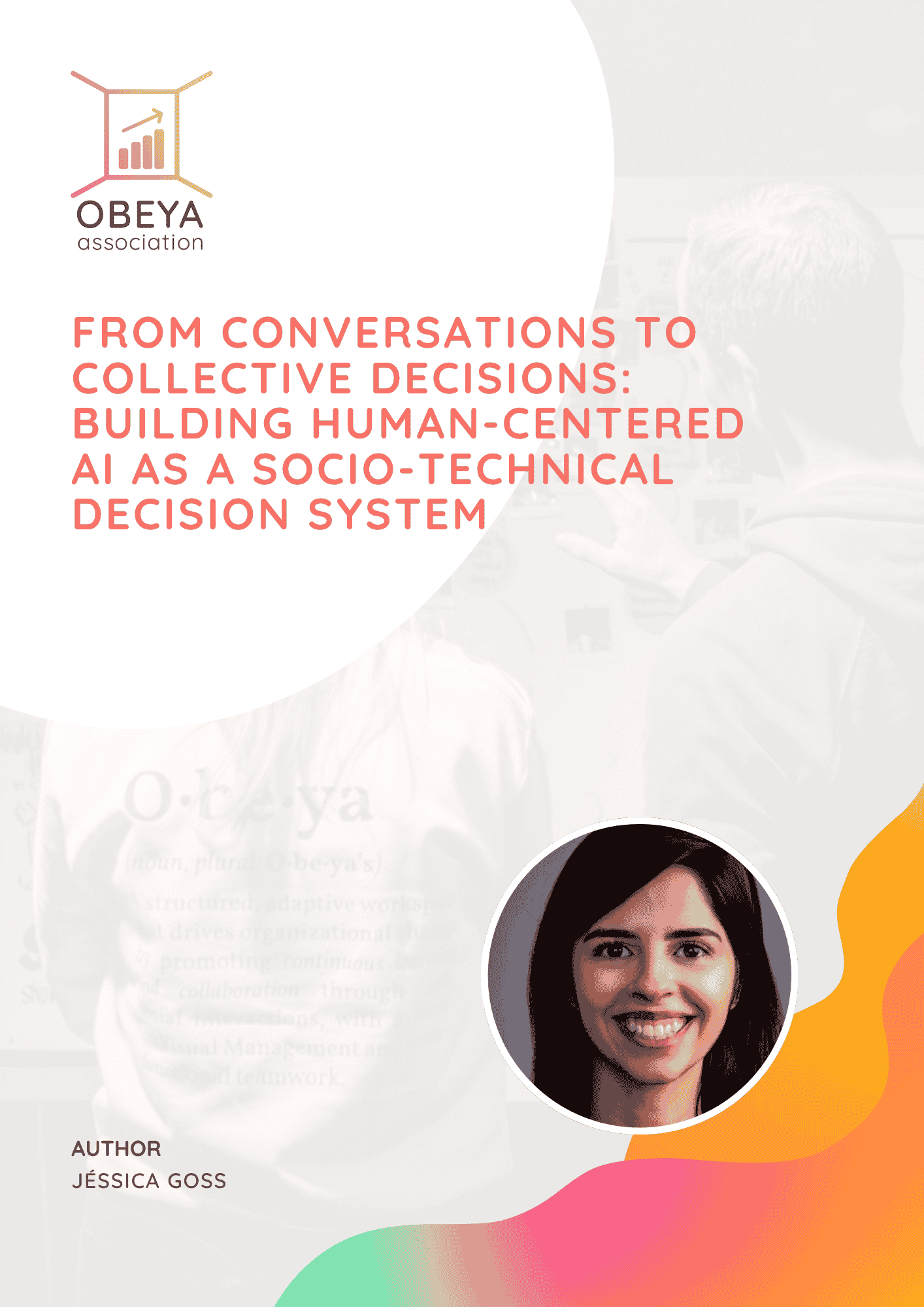
See Jessica live at the Obeya Summit 2026
Join Jessica at the Obeya Summit 2026 and learn how Human-Centered AI and Obeya principles helped create Mijke the Matchbot, a socio-technical decision system that supports citizens, social workers, and municipalities in addressing complex societal challenges.
Related Articles

Making the Invisible Visible – How Obeya Drives Safe Execution on Complex Capital Projects
Author of this article: Nynke Bel Nynke Bel is ...
Strategy Execution with Obeya-driven Portfolio Management
Author of this article: Felice Davies, Jelger Haanstra and ...

No Title – No Problem
Author of this article: Berrie Duijx Berrie Duijx is ...